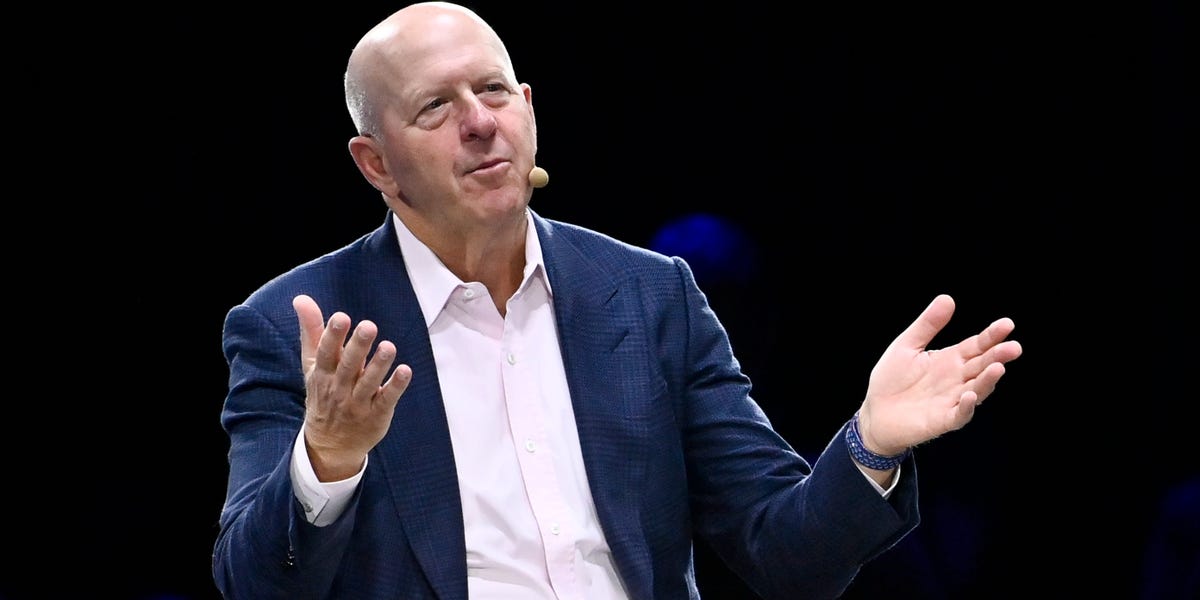
Goldman Sachs CEO Sounds Alarm: Is an AI Stock Market Drawdown Looming?
In an era increasingly defined by artificial intelligence, the financial world stands at a crossroads. As generative AI breakthroughs captivate global imagination and investment dollars flood into the sector, a voice of caution has emerged from one of Wall Street's most influential figures. David Solomon, CEO of Goldman Sachs, has issued a stark warning to investors, suggesting that the current AI-driven stock market frenzy might be overdone and that a significant "drawdown" could be on the horizon. This perspective from the head of a global investment giant demands serious consideration, prompting investors to assess the landscape of the david solomon markt outlook with a critical eye.
While the name David Solomon might also bring to mind an acclaimed artist known for his abstract expression and unique depictions of space, our focus here is squarely on the financial insights of the Goldman Sachs CEO. His recent remarks at Italian Tech Week in Turin have resonated across financial circles, drawing parallels between today's AI enthusiasm and the infamous dot-com bubble of the late 1990s and early 2000s. With major US stock indexes reaching unprecedented highs on the promise of AI, Solomon's warning serves as a crucial reminder to temper optimism with prudent risk assessment.
Echoes of the Dot-Com Era: Solomon's Historical Perspective
Solomon’s primary argument hinges on historical precedent. He vividly recalls the internet craze that gripped the financial markets decades ago, a period characterized by fervent investment in countless tech companies, many of which had unproven business models or lacked fundamental profitability. The ensuing collapse of these firms, widely known as the "dot-com bubble burst," wiped out fortunes and left many investors reeling. "You’re going to see a similar phenomenon here," Solomon predicted, adding, "I wouldn’t be surprised if in the next 12 to 24 months, we see a drawdown with respect to equity markets."
This comparison isn't meant to diminish the transformative potential of AI itself, but rather to highlight the speculative nature of current market valuations. During the dot-com era, while companies like Amazon and Google eventually emerged as titans, countless others, despite promising concepts, failed to deliver sustainable returns. The frenzy led to overvaluation, where companies with minimal revenue but high "potential" commanded exorbitant market caps. Solomon believes a similar dynamic is at play now:
- Overcapitalization: Too much capital is chasing too few genuinely disruptive or profitable opportunities.
- Undelivered Returns: Many investments made today, fueled by excitement rather than robust due diligence, are unlikely to generate the promised returns.
- Investor Sentiment: When investors are overly excited, they tend to focus solely on upside potential, neglecting inherent risks.
Solomon emphasizes that a drawdown doesn't necessarily equate to a catastrophic market collapse, but rather a significant correction or period of negative performance as the market recalibrates expectations. It's a natural, albeit painful, part of market cycles where unsustainable growth is pruned away, allowing truly valuable innovations to eventually shine. For a deeper dive into these historical parallels, consider reading about the AI Investment Frenzy: Solomon Compares to Dot-Com Bubble.
The AI Investment Landscape: Navigating Excitement and Risk
The current landscape is undeniably exciting. From autonomous vehicles to advanced drug discovery, AI promises to revolutionize nearly every industry. This optimism has been amplified by significant government and private sector initiatives, such as the announced $500 billion investment over the next four years into building new AI infrastructure, a collaboration involving tech giants like SoftBank, OpenAI, and Oracle.
However, Solomon's warning serves as a crucial counterpoint to this pervasive enthusiasm. While acknowledging AI's immense potential, he cautions against the uncritical deployment of capital. Not every company leveraging AI will be a winner, and the race to fund these ventures often overlooks crucial factors such as:
- Scalability and Profitability: Can the AI solution scale effectively and generate sustainable profits, or is it merely a proof-of-concept?
- Competitive Advantage: Does the company possess a durable competitive moat, or can its innovations be easily replicated?
- Fundamental Valuation: Are current stock prices justified by underlying earnings, assets, and future cash flow projections, or purely by speculative growth expectations?
- Ethical and Regulatory Hurdles: The nascent AI industry faces significant evolving challenges related to ethics, data privacy, and government regulation, which could impact growth and profitability.
The challenge for investors within the dynamic david solomon markt perspective is to differentiate between genuine innovation poised for long-term growth and speculative ventures that merely ride the wave of hype. Solomon himself refrains from using the term "bubble," acknowledging the unpredictable nature of market paths, but his message is clear: the risk curve has steepened, and many are "out on the risk curve because they’re excited."
Preparing for the Drawdown: Strategies for Investors
If a drawdown is indeed on the horizon, as David Solomon suggests, what actionable steps can investors take to safeguard their portfolios and position themselves for future growth?
- Diversify Your Portfolio: Avoid overconcentration in any single sector, especially those experiencing rapid, speculative growth. Spread investments across different industries, asset classes (stocks, bonds, real estate), and geographies to mitigate risk.
- Focus on Fundamentals: Prioritize companies with strong balance sheets, consistent earnings, proven business models, and clear paths to profitability. Look beyond the buzzword "AI" and delve into how a company is actually leveraging the technology to create tangible value.
- Practice Due Diligence: Don't invest based on headlines or social media hype. Research companies thoroughly, understand their competitive landscape, management team, and long-term strategy.
- Adopt a Long-Term Perspective: Market drawdowns are a normal part of economic cycles. Short-term volatility can be unnerving, but a long-term investment horizon allows for recovery and growth over time. Avoid panic selling during downturns.
- Maintain a Cash Reserve: Having some dry powder can be beneficial. A market drawdown presents opportunities to acquire quality assets at lower prices.
- Reassess Your Risk Tolerance: Understand your personal comfort level with risk. If a potential drawdown keeps you awake at night, it might be time to adjust your portfolio's risk profile.
These strategies are timeless principles of sound investing, even more critical during periods of heightened market exuberance. Solomon's warning is not an indictment of AI itself, but a call for rationality in investment decisions within the broader market. It's about ensuring capital is deployed wisely, fostering sustainable growth rather than fueling speculative bubbles that ultimately burst.
Beyond the Hype: Long-Term Outlook for AI and Markets
Despite the warnings of a potential drawdown, the long-term prospects for artificial intelligence remain incredibly promising. AI is not merely a fad; it's a foundational technology that will reshape industries and economies globally. The key for investors is to differentiate between the speculative froth and the underlying value creation.
A market correction could, in fact, be a healthy cleansing process, separating genuinely innovative and well-managed AI companies from those built on unsustainable hype. This period of recalibration could create clearer pathways for sustained, fundamental growth for the true pioneers in the field. Companies that can demonstrate real-world applications, strong customer adoption, and a clear return on investment for their AI endeavors will ultimately emerge stronger.
David Solomon's cautionary stance on the david solomon markt isn't about shying away from innovation, but about embracing it responsibly. It’s about learning from past mistakes to build a more resilient and sustainable future for technology investments. The evolution of AI, much like the abstract, layered narratives in art, requires careful observation and an understanding that true depth often lies beyond the immediate surface. Indeed, understanding the artist David Solomon's approach to depicting "space without defining it" might offer a metaphorical lens through which to view the current undefined, yet captivating, market territories. For more artistic insights, explore Exploring David Solomon's Abstract Art Legacy.
In conclusion, David Solomon's warning from Goldman Sachs serves as a timely reminder that while innovation sparks excitement, prudence must guide investment decisions. The journey through the AI revolution will undoubtedly be transformative, but it will also likely be marked by periods of correction and recalibration. By adopting a disciplined, long-term approach grounded in fundamental analysis, investors can navigate the potential drawdown and position themselves to benefit from the profound, enduring impact of artificial intelligence.